Embarking on a strength training journey can feel like stepping into uncharted territory. The sheer volume of information, complex jargon, and endless exercise variations can be overwhelming, often leading to confusion and a stalled start. But what if building a stronger, more resilient body was more straightforward than you imagined? The truth is, with a focused approach and a few fundamental movements, you can lay a powerful groundwork for lifelong fitness.
This is precisely the philosophy behind the new Men’s Health Beginner’s Guide to Muscle workout program, developed by strength and performance coach Kurt Ellis, C.S.C.S. This program, accessible to MH MVP Premium members, is meticulously crafted to equip beginners, and those returning to fitness, with the essential tools to initiate a sustainable training practice and set them on the path to achieving their physical aspirations.
At its core, effective strength training for beginners hinges on mastering a select few compound movements. These exercises engage multiple muscle groups simultaneously, providing the most bang for your buck in terms of building strength, muscle, and functional fitness. The beauty of these foundational movements is their versatility; they can be performed with a simple pair of dumbbells, allowing you to train effectively virtually anywhere.

Here, Coach Ellis shares four cornerstone dumbbell exercises that form the bedrock of a successful beginner’s strength program. By focusing on these, you’ll build the strength, coordination, and muscle mass needed to progress confidently on your fitness journey.
The Pillars of Progress: 4 Dumbbell Exercises for a Stronger You
Building muscle isn’t about performing dozens of obscure exercises. It’s about mastering the fundamentals and progressively challenging your body. The following four dumbbell exercises are chosen for their ability to stimulate significant muscle growth, improve functional strength, and build a solid foundation for more advanced training.
1. Romanian Deadlift (RDL)

WHY IT’S KEY:
The Romanian Deadlift (RDL) is a fundamental hinge movement that is paramount for developing the posterior chain – the group of muscles on the back of your body, including your hamstrings, glutes, and lower back. "This simple hinge move sets the tone for everything," states Ellis. "It teaches your body how to effectively pick up heavy loads from the ground, a crucial skill for both athletic performance and everyday life. Strengthening these muscles is vital for posture, injury prevention, and overall power."
HOW TO DO IT:
- Starting Position: Stand with your feet hip-width apart, holding a dumbbell in each hand in front of your thighs. Your palms should face your body. Maintain a slight bend in your knees throughout the entire movement; do not lock them out.
- The Hinge: Keeping your back straight and your core engaged, hinge at your hips, pushing your glutes backward as if you are trying to touch a wall behind you with your backside. Allow the dumbbells to lower down the front of your legs, keeping them close to your body.
- Lowering Phase: Lower the dumbbells until you feel a comfortable stretch in your hamstrings. This is typically around mid-shin level, but it depends on your individual flexibility. Do not round your back; maintain a neutral spine.
- Ascending Phase: Squeeze your glutes and drive your hips forward to return to the starting upright position. Focus on using your hamstrings and glutes to pull yourself up.
SETS AND REPS:
- 3 to 4 sets of 6 to 8 reps.
Practical Tip: Imagine you’re trying to close a door with your glutes as you return to the upright position. This cue can help you activate the correct muscles. Avoid letting your lower back round at any point; if you feel your back starting to round, you’ve gone too low.
2. Chest-Supported Row


WHY IT’S KEY:
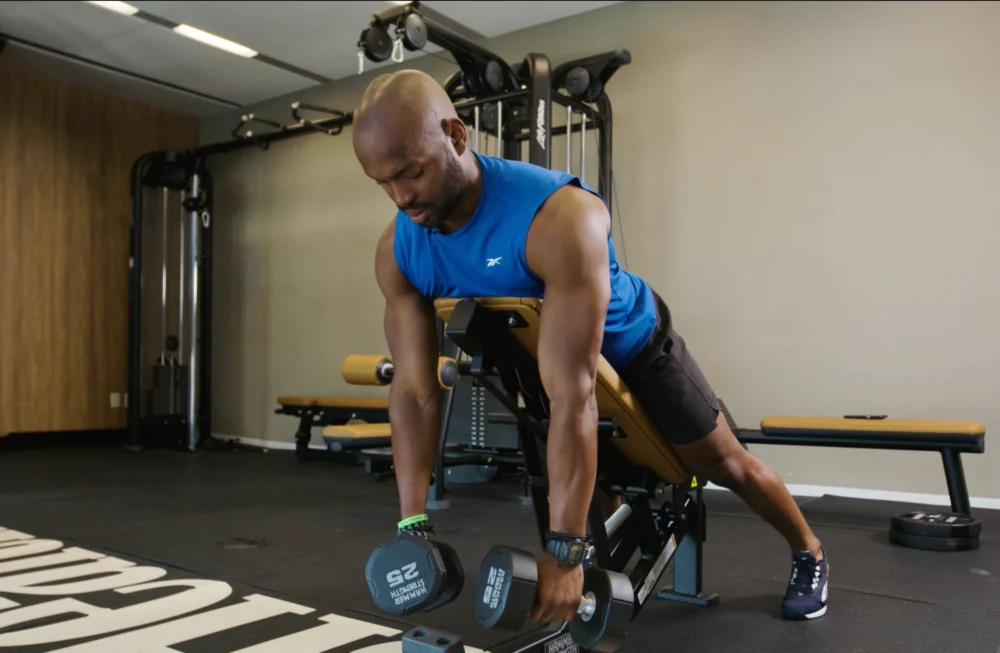
Pulling movements are essential for developing a strong and balanced physique, and the chest-supported row offers a significant advantage for beginners. "I prefer using the bench for rowing because it takes your lower back out of the equation," explains Ellis. "This allows you to fully concentrate on engaging the muscles of your mid and upper back, which are crucial for posture and shoulder health. You’ll also build vital grip strength, a key indicator of overall health and longevity."
HOW TO DO IT:
- Starting Position: Position yourself on an incline bench so that your chest is supported, but your hips are not. You should be able to reach the floor with your feet, which should be planted firmly. Hold a dumbbell in each hand, letting them hang straight down with your arms extended.
- The Pull: Keeping your chest pressed against the bench, engage your back muscles to pull the dumbbells up towards your chest. Focus on squeezing your shoulder blades together at the top of the movement. Imagine trying to tuck your elbows into your back pockets.
- Lowering Phase: Slowly and with control, lower the dumbbells back to the starting position, feeling a stretch in your back muscles.
- Core Engagement: Maintain a braced core throughout the exercise to keep your torso stable.
SETS AND REPS:
- 3 to 4 sets of 8 to 12 reps.
Real-Life Application: Think about rowing a boat. You want to pull with your back muscles, not just your arms. This exercise is excellent for improving the strength needed for everyday tasks like carrying groceries or lifting objects.
3. Goblet Squat

WHY IT’S KEY:
The squat is king when it comes to lower body strength and overall muscle building. The goblet squat variation is particularly effective for beginners because it promotes an upright torso and a deeper range of motion. "If you start with a goblet squat, you’ll challenge your quads, glutes, and core, and it teaches your body how to sit and stand with proper, functional form," Ellis emphasizes. It also helps improve thoracic mobility, which can be a limiting factor in other squat variations.
HOW TO DO IT:
- Starting Position: Stand with your feet slightly wider than hip-width apart, toes pointed slightly outward. Hold a single dumbbell vertically against your chest with both hands, cupping the top end of the dumbbell.
- The Descent: Keeping your chest up and your core tight, initiate the squat by pushing your hips back and bending your knees. Aim to descend as low as you can while maintaining a neutral spine and keeping your heels on the ground. Your elbows should ideally track inside your knees.
- The Ascent: Drive through your heels and squeeze your glutes to return to the standing position.
SETS AND REPS:
- 3 to 4 sets of 8 to 12 reps.
Beginner’s Insight: If you struggle to get deep enough, try placing a small plate or yoga block under your heels. This can help improve ankle mobility and allow for a better squat depth. Focus on the quality of each repetition over the quantity.
4. Dumbbell Bench Press

WHY IT’S KEY:
Pushing movements are fundamental for developing upper body strength and building a strong chest, shoulders, and triceps. The dumbbell bench press offers a greater range of motion and allows for more independent arm movement compared to a barbell press, which can be beneficial for correcting muscle imbalances. "Building pushing strength is key," Ellis notes. "You’ll blast your chest, shoulders, and triceps in the process." This exercise contributes significantly to upper body aesthetics and functional strength.
HOW TO DO IT:
- Starting Position: Lie flat on a bench with your feet planted firmly on the floor. Hold a dumbbell in each hand at chest level, with your palms facing each other or slightly turned inward. Your elbows should be at about a 45-degree angle from your body.
- The Press: Press the dumbbells straight up towards the ceiling, extending your arms but without locking your elbows at the top. Keep your wrists straight and stacked over your forearms.
- Lowering Phase: Slowly and with control, lower the dumbbells back down to your chest, feeling a stretch in your chest muscles.
- Stability: Engage your glutes and press your upper back into the bench for stability.
SETS AND REPS:
- 3 sets of 8 to 10 reps.
Workout Tip: Focus on the mind-muscle connection. Try to feel your chest muscles working as you press the weight up and control the descent. Don’t be afraid to slightly adjust your grip width to find what feels most comfortable and effective for your chest.
Putting It All Together: Your Path to Consistent Progress
Mastering these four dumbbell exercises provides a robust foundation for muscle growth and strength development. Incorporate them into your routine consistently, focusing on proper form and progressive overload – gradually increasing the weight, repetitions, or sets over time.

If you’re looking for a structured plan that details how to implement these exercises, along with guidance on progression and overall programming, consider exploring the Beginner’s Guide to Muscle workout program. This comprehensive resource, available exclusively for MH MVP Premium members, provides the roadmap you need to build sustainable strength and achieve lasting results.
Remember, consistency is your greatest ally. Don’t get discouraged by the learning curve. Every workout is a step forward, a testament to your commitment to a healthier, stronger you. Embrace the process, celebrate your progress, and build a physique that reflects your dedication. Your strength journey starts now.