The modern lifestyle often chains us to our chairs, leaving our bodies feeling tight, compressed, and anything but mobile. If you find yourself constantly battling a stiff neck, aching shoulders, or a general feeling of being "stuck" in your upper back, you’re not alone. The culprit? Your thoracic spine, the often-neglected middle section of your backbone, which bears the brunt of our sedentary habits.
Your thoracic spine, or T-spine, encompasses the vertebrae from just below your neck down to your waist. It’s the critical link that allows your rib cage to expand, your shoulder blades to move, and, crucially, enables the rotational movements essential for everyday tasks and athletic performance. When you spend hours hunched over a keyboard, gripping a steering wheel, or simply slouching on the sofa, your T-spine gets locked into a forward-flexed position, leading to stiffness, reduced mobility, and potentially, discomfort.
But the good news is, you can actively fight back. By incorporating targeted thoracic spine mobility exercises into your routine, you can unlock this vital area, improve your posture, alleviate stiffness, and enhance your overall movement quality. This article will guide you through four powerful, yet accessible, stretches designed to reawaken your T-spine and get you feeling fluid and functional again.
Understanding Your Thoracic Spine: The Core of Your Movement
Before we dive into the stretches, let’s clarify what exactly your thoracic spine is and why its mobility is so important. Comprising 12 vertebrae (T1 through T12), this section of your spine is uniquely designed for stability and rotation. Unlike your cervical (neck) and lumbar (lower back) spines, which are built for more forward and backward bending, the thoracic spine is optimized for twisting. Your shoulder blades attach to its posterior surface, and your rib cage, which protects your heart and lungs, also connects here.
This intricate structure allows for a significant range of motion, enabling you to look over your shoulder, reach for objects, and perform powerful rotational movements in sports like golf, tennis, or baseball. However, prolonged sitting and poor posture can significantly limit this natural rotation, forcing other parts of your spine to compensate, often leading to strain and pain.
Who Can Benefit from Thoracic Spine Mobility?
The short answer is: almost everyone. However, certain groups stand to gain exceptional benefits from dedicating attention to their thoracic spine:
- Desk Workers and Sedentary Individuals: If your job involves long hours at a computer, driving, or any activity that keeps you seated, your T-spine is likely experiencing a consistent, forward-flexed posture. Regular T-spine mobility work can counteract this, preventing the development of a hunched posture and associated discomfort.
- Athletes: Whether you’re a golfer, tennis player, pitcher, or CrossFit enthusiast, rotational power is often a key component of your performance. A stiff thoracic spine can limit this power and increase the risk of injury. Incorporating these stretches as part of your warm-up or cool-down can significantly enhance your athleticism.
- Individuals Experiencing Upper Back Pain: Chronic stiffness and pain in the mid-back can often be traced back to limited thoracic mobility. By improving movement in this area, you can often alleviate tension and reduce pain.
Important Note: While these stretches are generally safe and beneficial, always listen to your body. If you experience sharp or persistent pain, discontinue the exercise and consult with a healthcare professional, such as a physical therapist or physician.
4 Essential Thoracic Spine Stretches to Loosen Up
These four exercises are designed to target different aspects of thoracic spine mobility – extension, rotation, and lateral flexion. They can be performed individually or as a sequence.
1. The "Open Book" Stretch: Unwinding the Twists
This classic mobility drill is a fantastic way to gently encourage rotation in your thoracic spine and improve the mobility of your rib cage. It’s particularly beneficial for counteracting the effects of prolonged sitting.
Why it works: By lying on your side and opening your upper body, you create a controlled rotational movement through your mid-back, allowing you to explore your range of motion without strain.
How to do it:
- Starting Position: Lie on your side with your knees bent and stacked at a 90-degree angle. Your arms should be extended straight out in front of you, palms together. Ensure your hips are stacked and not rolling backward.
- The Movement: Keeping your knees glued together, slowly rotate your top arm and shoulder backward, reaching towards the floor behind you. As you rotate, your head should follow your hand, allowing your gaze to turn upwards. Try to keep your bottom shoulder blade pressed gently into the floor.
- The Hold: Hold the stretched position for a breath or two, focusing on the gentle rotation in your mid-back. You should feel a stretch across your chest and into your upper back.
- Return: Slowly bring your arm back to the starting position, maintaining control.
- Repetitions: Aim for 10 controlled repetitions on each side.
Practical Tip: Focus on the rotation originating from your mid-back, rather than just moving your arm. Imagine your spine is like a book opening up.
2. Quadruped Rotation: Engaging Core and Spine
This dynamic movement, performed on your hands and knees, effectively mobilizes your thoracic spine while also engaging your core muscles for stability. It’s an excellent way to prepare your spine for more complex movements.
Why it works: The quadruped position provides a stable base, allowing you to focus on controlled rotation through your thoracic spine. It also helps improve shoulder stability and coordination.
How to do it:

- Starting Position: Get on your hands and knees, with your hands directly under your shoulders and your knees directly under your hips. Your back should be in a neutral position – not arched or rounded.
- The Movement: Place one hand behind your head, with your elbow pointing upwards. Keeping your hips as still as possible, rotate your torso, bringing your elbow towards the hand that’s on the floor. Imagine you’re trying to "look" under your elbow.
- The Reach: From the rotated position, extend your elbow upwards towards the ceiling, opening your chest and creating a larger rotational movement.
- Return: Slowly bring your elbow back towards your hand, then return to the starting position.
- Repetitions: Aim for 12 to 15 controlled repetitions on each side.
Real-Life Example: Think of this as a controlled version of checking your blind spot in your car, but with a focus on isolating the movement to your mid-back.
Workout Tip: To maximize the benefit, consciously try to keep your hips stable throughout the movement. This ensures the rotation is coming from your thoracic spine, not your lower back.
3. The "Preacher" Stretch: Opening Up for Overhead Movements
This stretch utilizes a stable surface, like a bench or sturdy chair, to facilitate thoracic extension and rotation, making it ideal for anyone who performs overhead lifts or experiences tightness in their upper back from prolonged forward posture.
Why it works: By propping yourself up on your elbows, you create leverage that allows for a deeper stretch into thoracic extension and rotation, effectively "opening up" the front of your chest and the posterior aspect of your mid-back.
How to do it:
- Starting Position: Kneel in front of a sturdy surface (bench, chair, box) that is roughly the height of your abdomen when kneeling. Place your elbows on the surface, shoulder-width apart, with your forearms pointing upwards.
- The Movement: Gently lower your chest towards the floor, allowing your thoracic spine to extend. You should feel a stretch in your upper back and potentially your chest.
- Adding Rotation (Optional but Recommended): From the extended position, you can add a rotational element by reaching one arm towards the ceiling, following your hand with your gaze.
- The Hold: Hold the stretched position for a breath or two.
- Return: Slowly press yourself back up to the starting position.
- Repetitions: Aim for 10 repetitions. If adding rotation, perform 5 on each side.
Workout Tip: This stretch is excellent as part of a warm-up before exercises like overhead presses, pull-ups, or even squats, as it helps prepare your thoracic spine for extension and overhead mobility.
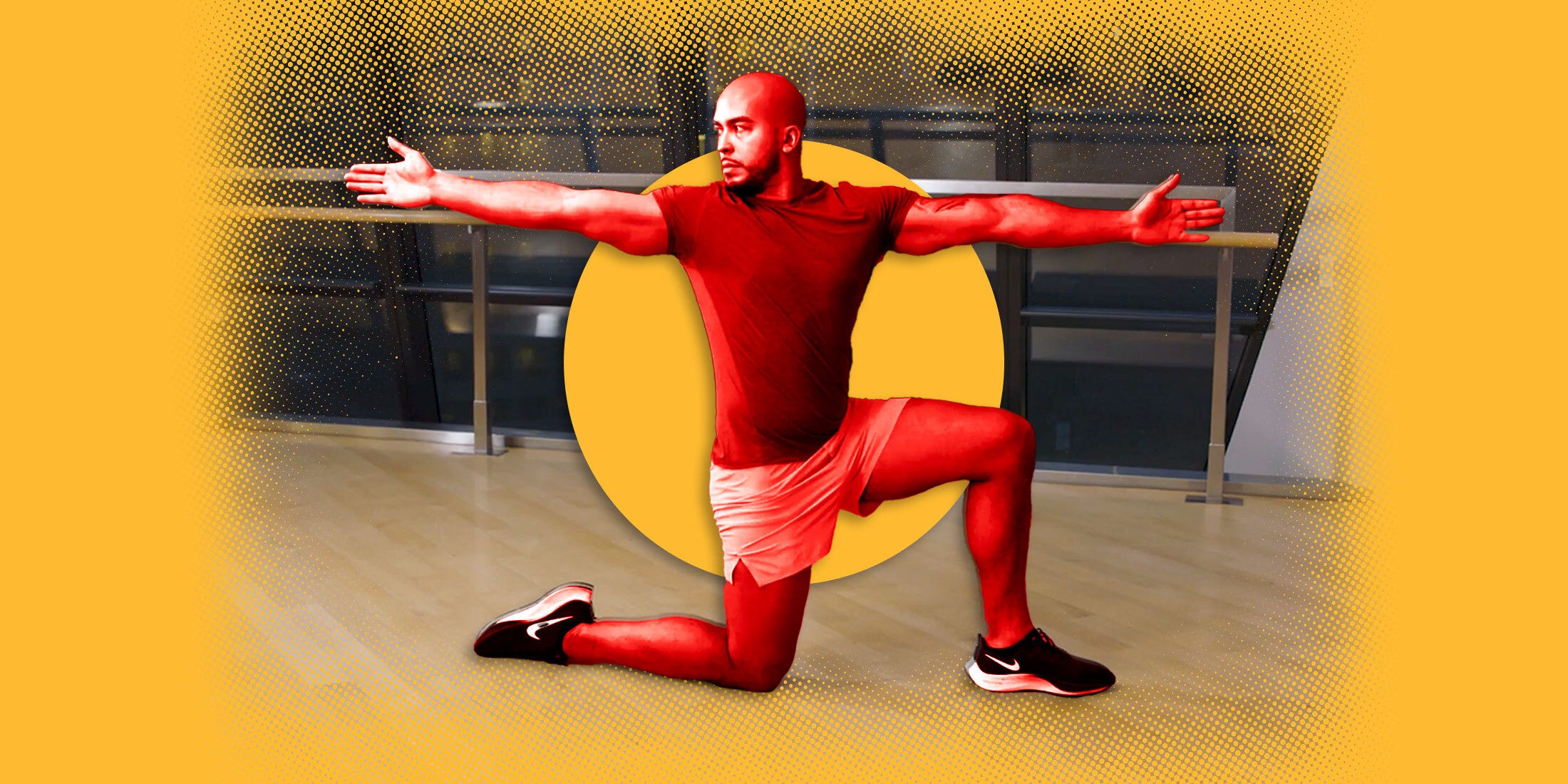
4. Half-Kneeling Thoracic Rotation: Releasing the Day’s Tension
This versatile stretch is perfect for unwinding at the end of a long day or as a dynamic warm-up for rotational movements. The half-kneeling position provides stability while allowing for a deep, controlled rotation through the thoracic spine.
Why it works: The half-kneeling stance helps isolate the rotation to the thoracic spine, preventing compensatory movements from the hips or lower back. It’s a powerful stretch for improving your ability to twist and turn.
How to do it:
- Starting Position: Assume a half-kneeling position. Place your right foot forward, with your knee bent at a 90-degree angle directly over your ankle. Your left knee should be on the floor, with a pad or mat for comfort if needed. Keep your torso upright and your core engaged.
- The Movement: Place your hands on the floor inside your front foot, with your elbow on your front knee. Rotate your torso upwards, reaching your top arm towards the ceiling. Follow your hand with your gaze. Imagine you are trying to open your chest towards the ceiling.
- The Hold: Hold the stretched position for a breath or two, focusing on the rotation through your mid-back.
- Return: Slowly bring your arm back to the starting position.
- Repetitions: Aim for 10 controlled repetitions on each side.
Real-Life Example: This stretch mimics the rotational movement needed to reach for something behind you on a shelf or to look over your shoulder during a sports movement.
Actionable Advice: When performing this stretch, focus on keeping your hips facing forward as much as possible. This will ensure that the rotation is originating from your thoracic spine, rather than just your shoulders.
Integrating T-Spine Mobility into Your Life
The beauty of these stretches is their versatility. You don’t need to dedicate hours in the gym to reap the benefits. Here’s how to make them a seamless part of your day:
- Morning Wake-Up: Start your day by performing a few reps of each stretch to awaken your spine and improve your posture before you even get out of bed or start your commute.
- Desk Breaks: Set a timer to remind yourself to take short breaks every hour or so. Use these moments to perform a few reps of the Open Book or Half-Kneeling Rotation.
- Pre-Workout Warm-up: Integrate the Quadruped Rotation and Preacher Stretch into your pre-exercise routine, especially if your workout involves overhead movements or rotational demands.
- Post-Workout Cool-down: Use the Open Book and Half-Kneeling Rotation to help restore mobility and alleviate any tightness that may have developed during your training session.
- Evening Unwind: Before bed, a few gentle reps of these stretches can help release the tension accumulated throughout the day, promoting better sleep and recovery.
The Power of Consistent Movement
Your thoracic spine is a crucial component of your body’s ability to move freely and efficiently. By neglecting its mobility, you’re not just accepting stiffness; you’re limiting your potential for athletic performance, increasing your risk of injury, and potentially contributing to chronic pain.
The good news is that reclaiming your T-spine’s mobility is within your reach. These four essential stretches offer a powerful, accessible, and effective way to combat the effects of modern life. Consistency is key. Even a few minutes each day dedicated to these movements can lead to significant improvements in your posture, flexibility, and overall sense of well-being.
Don’t let stiffness dictate your movement. Embrace these thoracic spine stretches, make them a habit, and unlock a more fluid, functional, and pain-free you. Your body will thank you for it.