In the pursuit of a sculpted physique and formidable functional strength, few movements are as fundamental and effective as the dumbbell row. Yet, it’s an exercise often performed with a cavalier attitude, leading to suboptimal gains and, more concerningly, potential injury. While many enthusiasts grab a heavy dumbbell and plant their knee on a bench with gusto, the true power of this back-building staple lies in precision, intention, and an understanding of biomechanics.
Your back muscles are the unsung heroes of your posture and everyday movement. They counteract the constant forward-facing demands of modern life – typing, driving, carrying – and a well-developed back provides a strong foundation for virtually every other physical activity. The dumbbell row, when executed correctly, is a masterclass in engaging these crucial muscles, fostering not just size and strength, but also resilience and improved posture. This article will guide you from the common pitfalls to the peak of performance, transforming your dumbbell rows into a true powerhouse exercise.
The Foundation of a Strong Back: Why Dumbbell Rows Matter
Before we dive into the mechanics, let’s understand why the dumbbell row is so vital. As fitness experts often emphasize, our daily lives tend to promote a "forward lean." We reach, we push, we hunch over devices. This consistent anterior-focused movement pattern can lead to muscle imbalances, poor posture, and even discomfort.
The dumbbell row, on the other hand, is a powerful horizontal pulling movement. It directly opposes those forward-leaning tendencies. By engaging your back muscles, you’re actively building the opposing force, creating a more balanced and resilient muscular system.
Key Muscles Activated:
- Latissimus Dorsi (Lats): These are the large, wing-like muscles on the sides of your back, responsible for pulling your arms down and back. They contribute significantly to back width.
- Rhomboids: Located between your shoulder blades, these muscles are crucial for retracting your shoulder blades (pulling them together) and improving upper back posture.
- Trapezius (Traps): Particularly the mid and lower traps, which help stabilize the shoulder blades and contribute to overall upper back thickness.
- Rear Deltoids: The back of your shoulder muscles, which assist in pulling movements and are often underdeveloped, contributing to rounded shoulders.
By intelligently incorporating the dumbbell row into your training, you’re not just building a bigger back; you’re building a more functional, injury-resistant, and aesthetically balanced physique.
Decoding the Dumbbell Row: Beyond the Basic Setup
The traditional dumbbell row, with one knee and one hand on a bench, is a common sight. However, the typical execution often invites inefficiencies and compromises. The key to unlocking its full potential lies in refining your stance and understanding the subtle but crucial cues that maximize muscle engagement and minimize risk.

The Superior Stance: Elevating Your Support
Many fitness enthusiasts place their knee directly on top of the bench. While this offers a form of support, it can inadvertently compromise spinal alignment and limit the range of motion for your back muscles. A more effective and spine-friendly approach involves shifting your stance.
The Corrected Setup:
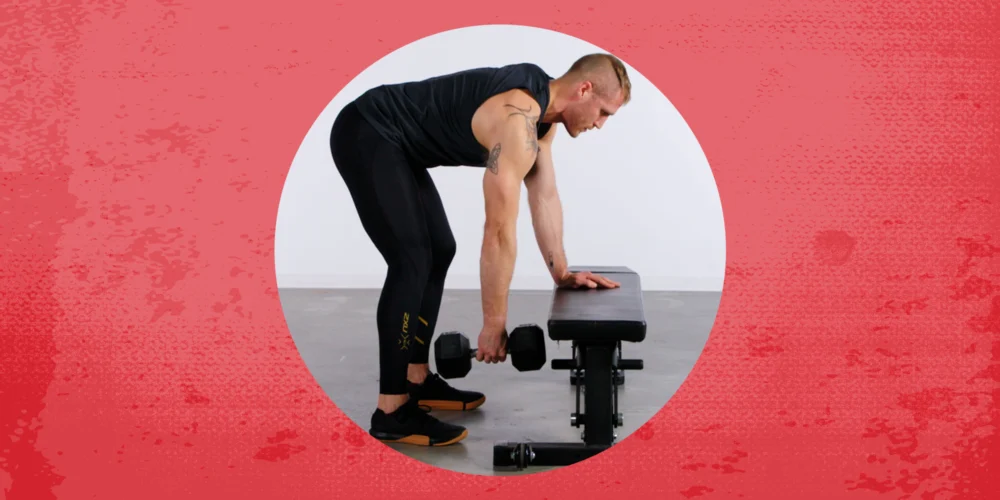
- Positioning: Stand next to a sturdy bench. Place one hand firmly on the bench for support.
- Foot Placement: Instead of tucking your knee under your body, step your feet wider apart, creating an even, stable base. Your working leg should be roughly underneath your hips, and your non-working leg extended back slightly for balance.
- Hinging at the Hips: Hinge forward at your hips, maintaining a neutral spine. Imagine pushing your hips backward. Your torso should be angled downwards, but not so much that your hips are significantly higher than your shoulders.
- Core Engagement: Crucially, keep your core braced throughout the entire movement. This stability is paramount for protecting your lower back and ensuring your back muscles do the work.
- Shoulder Alignment: Ensure your shoulders are slightly higher than your hips. This slight upward angle helps engage your back extensors, further protecting your lower back.
This adjusted stance provides a more balanced platform, allowing for better hip and spinal control, which translates directly into more effective muscle recruitment and reduced risk of strain.
The Crucial First Move: Squeeze Those Shoulder Blades!
This is arguably the most overlooked, yet most important, cue for a successful dumbbell row. Before you even think about pulling the weight, initiate the movement by actively squeezing your shoulder blades together.
Why This Matters:
- Prevents Rounding: It immediately sets your upper back in a strong, stable position, preventing the tendency to round your shoulders forward.
- Shoulder Health: By engaging the muscles that control your shoulder blades, you create a safer environment for your shoulder joint, reducing stress on the labrum and rotator cuff tendons.
- Maximizes Muscle Activation: This initial squeeze ensures that your rhomboids and traps are engaged from the outset, setting the stage for a more complete lat contraction during the pull.
Make this shoulder blade squeeze an intentional part of every single repetition, especially as you’re learning. As you progress, it will become a natural, fluid part of the rowing motion.
The Art of the Pull: Engage Your Back, Not Your Biceps
It’s incredibly easy to let your biceps take over during a row. You grab the dumbbell, and your arms just… curl. While biceps will naturally be involved to some degree, they should not be the primary driver of the movement.

How to Keep the Focus on Your Back:
- Think Elbow, Not Hand: Instead of focusing on pulling the dumbbell towards your chest, concentrate on pulling your elbow upwards and backward. Imagine trying to drive your elbow towards the ceiling.
- Forearm as a Hook: Visualize your forearm as a large, strong hook that’s gripping the dumbbell. The motion should originate from the muscles in your back, pulling that hook upwards.
- Controlled Descent: Don’t let the dumbbell simply drop. Control its descent, feeling a stretch in your lats at the bottom of the movement. This eccentric (lowering) phase is just as crucial for muscle growth as the concentric (lifting) phase.
By shifting your mental focus and your physical intention to the elbow and the back muscles, you’ll ensure that your lats, rhomboids, and traps are doing the heavy lifting.
The Undeniable Benefits of the Dumbbell Row
The unilateral nature of the dumbbell row offers distinct advantages over bilateral (two-arm) exercises, especially those using fixed implements like barbells.
Key Advantages:
- Enhanced Range of Motion: Dumbbells allow for a greater range of motion. You can naturally pull the weight further up your torso and achieve a deeper stretch at the bottom without your torso colliding with the weight. This full range of motion is critical for maximizing muscle hypertrophy (growth).
- Addressing Imbalances: Since you perform the exercise one arm at a time, you can identify and correct any strength imbalances between your left and right sides. This leads to a more symmetrical and functionally sound physique.
- Core Stability Demands: While you use the bench for support, the single-arm nature still requires significant core engagement to prevent rotation and maintain stability. This further strengthens your midsection.
- Joint-Friendly: The controlled, independent movement of each arm can be easier on the shoulders and elbows for some individuals compared to barbell exercises, especially when dealing with specific mobility restrictions.
Common Pitfalls to Sidestep: Avoiding Dumbbell Row Mistakes
Even with the correct setup, several common errors can sabotage your progress and increase your risk of injury. Being aware of these mistakes is the first step to correcting them.
The Peril of Poor Posture
We’ve already touched on the knee-on-bench issue, but poor posture can manifest in other ways:
- Excessive Hinge: Bending over too far, so your hips are significantly higher than your shoulders, places undue stress on your lower back and shifts the emphasis away from the target back muscles. Aim for a torso angle where your hips are below shoulder level.
- Head and Shoulder Rotation: Avoid rotating your torso or lifting your head excessively as you pull. Keep your head in a neutral position, aligned with your spine.
- Swinging and Curling: The most blatant mistake is using momentum from your legs or torso to swing the weight up, or relying purely on a bicep curl. Focus on a controlled, deliberate pull driven by your back muscles.
The "Too Much, Too Soon" Syndrome
It’s tempting to load up the heaviest dumbbells immediately. However, mastering proper form with a lighter weight is paramount. Rushing into heavier loads with poor technique is a recipe for injury and inefficient muscle development.

Actionable Advice:
- Start Light: Begin with a weight that allows you to perform 10-12 repetitions with perfect form.
- Focus on Mind-Muscle Connection: Prioritize feeling the target muscles working. If you can’t feel your back contracting, the weight is too heavy.
- Gradual Progression: Once you can comfortably complete your target reps with good form, then you can incrementally increase the weight.
Neglecting the Eccentric Phase
The lowering portion of the dumbbell row is often rushed or completely uncontrolled. This is a missed opportunity for muscle growth.
How to Master the Descent:
- Slow and Steady: Lower the dumbbell with control over 2-3 seconds.
- Feel the Stretch: Allow your lat to lengthen at the bottom of the movement, creating a satisfying stretch.
- Maintain Tension: Don’t let the weight simply drop. Keep tension on the muscles throughout the entire range of motion.
Integrating Dumbbell Rows Into Your Training Program
The dumbbell row is a versatile exercise that can be a cornerstone of any back or upper body training day.
Recommended Guidelines:
- Frequency: Include dumbbell rows 1-2 times per week, typically on your back or upper body training days.
- Sets and Reps: For muscle growth (hypertrophy), aim for 3 sets of 8-12 repetitions per arm.
- Strength Focus: Once your form is solid, you can incorporate heavier weights for 3 sets of 6-8 repetitions per arm to build more strength.
- Workout Placement: It’s generally best to perform dumbbell rows earlier in your workout when you have more energy and can focus on form, before fatigue sets in from other exercises.
Example Workout Integration:
- Back Day:
- Pull-ups (or assisted pull-ups): 3 sets to failure
- Single-Arm Dumbbell Row: 3 sets of 8-12 reps per arm
- Barbell Rows (or another compound row variation): 3 sets of 8-10 reps
- Face Pulls: 3 sets of 12-15 reps
Choosing the Right Tools: Dumbbells for Your Goals
The type of dumbbells you use can impact your workout experience. While any dumbbell will suffice to start, consider these options as you progress:

- Hex Dumbbells: Their hexagonal shape prevents them from rolling, making them stable and safe when placed on the floor between sets. They are a versatile and cost-effective option for most home gyms.
- Dumbbell Sets with Racks: For those with dedicated home gym space and a desire for variety, a set of dumbbells with a vertical rack offers a convenient way to access multiple weight options without clutter.
- Adjustable Dumbbells: These are excellent space-savers and offer a wide range of weight increments. They are ideal for those with limited space or who want to seamlessly transition between different weights for various exercises.
Investing in quality equipment that suits your training environment and goals will enhance your consistency and enjoyment.
The Path to a Powerful Back Starts Now
The dumbbell row is more than just an exercise; it’s a fundamental movement that builds a strong, balanced, and resilient back. By understanding the nuances of its execution – from the optimal stance and deliberate muscle engagement to the avoidance of common errors – you transform this staple exercise into a powerful tool for physical development.
Don’t let sloppy form or a lack of focus hold you back. Embrace the precision, feel the muscles working, and witness the incredible transformation of your back. Each controlled pull, each squeeze of the shoulder blades, is a step towards a stronger, more capable you. Make the dumbbell row your ally, and forge the powerful back you’ve always desired. Your journey to unshakeable strength begins with the perfect row.