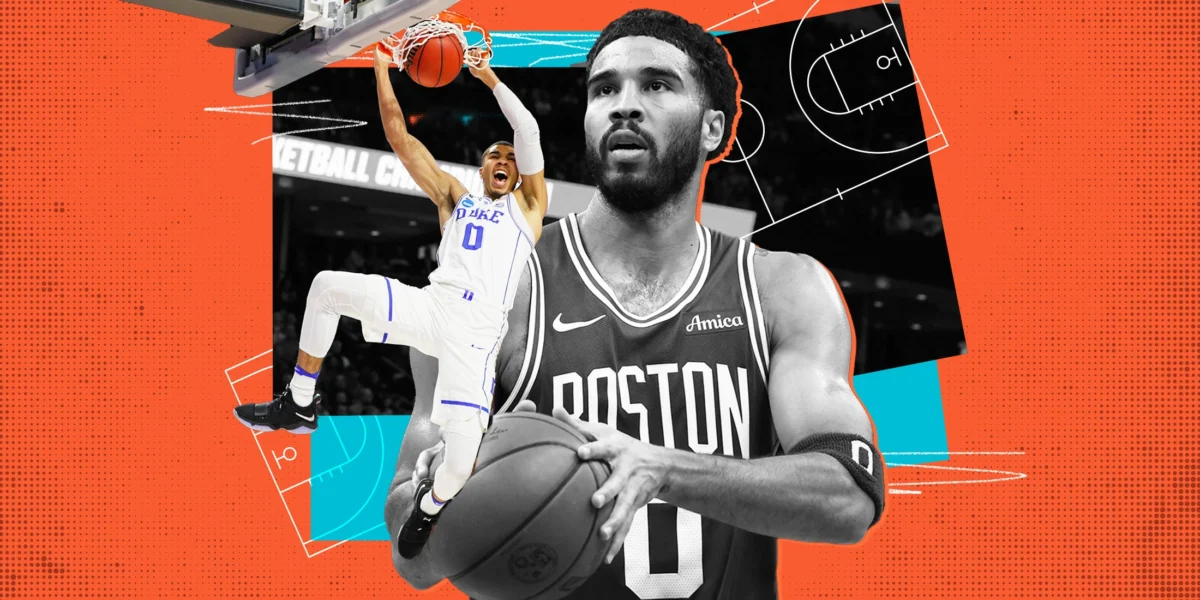
The electrifying roar of the crowd, the nail-biting finishes, the sheer unpredictability – March Madness holds a special place in the hearts of basketball fans. For many, it’s a nostalgic reminder of childhood dreams and aspirational leaps. For Boston Celtics superstar Jayson Tatum, it was the soundtrack to his youth, a period where he was "glued to the TV," absorbing every thrilling moment. Now, this six-time All-Star and NBA Champion isn’t just watching March Madness; he’s a featured presence in a poignant commercial, "Baby’s First Dunk," for AT&T, underscoring the powerful theme of connection that has defined his own remarkable basketball odyssey.
Tatum’s journey to NBA stardom is deeply intertwined with the legacy of his alma mater, Duke University, a program synonymous with March Madness success. While his early childhood aspirations weren’t fixed on Duke, his burgeoning talent in high school brought the iconic Blue Devils into sharp focus. "As I got older, I started to gain more knowledge in what I wanted to do and accomplish," Tatum reflects. "Going to Duke was very appealing because of their track record and being on the biggest stage, all the primetime games."
The Allure of Elite Competition
The draw of high-level competition was undeniable. Tatum vividly recalls his first UNC vs. Duke rivalry game at the legendary Cameron Indoor Stadium as a core memory, a game his team ultimately won. His sole ACC Tournament experience in 2017 was a testament to resilience and team synergy. Entering as a five-seed, the Blue Devils embarked on an improbable run, winning four games in four days to claim the championship – a feat that made them the first team in history to achieve such a victory from that seeding. "That was a special week," Tatum states, his voice still carrying the weight of that triumphant accomplishment.
While Duke’s March Madness campaign that year ended in the second round, the experience fueled Tatum’s ambition. Just three months later, his lifelong dream materialized as he was selected as the third overall pick in the 2017 NBA Draft by the Boston Celtics.
Embracing the Leap: From College Courts to the Professional Arena
The decision to leave Duke after just one year was not made lightly. "It wasn’t an easy decision. I wasn’t ready to leave," Tatum admits. "But my lifelong dream was to go to the NBA." Today, he remains deeply connected to the program, returning to Durham most summers and serving as the Chief Basketball Officer. In this role, he acts as a sounding board for coaches and players, offering insights to further enhance the program’s success. His dedication extends to watching as many Duke games as possible, and he’s a fervent supporter of their quest for another championship. The 2026 tournament saw the Blue Devils enter as a 1-seed, navigating a challenging first-round matchup and securing a decisive victory in the second, setting the stage for their Sweet Sixteen showdown.
The inherent drama of March Madness, with its "win or go home" mentality, resonates deeply with Tatum. He highlights how the unique matchups, often featuring teams that don’t clash in the regular season, coupled with unfamiliar cities and atmospheres, elevate the fan and player experience. "All of those factors really heighten the experience for the fans, the teams, and bring out the best in the athletes," he observes. "We’ve seen it—on any given day, anybody can win, and that’s what we love about it."

Navigating Adversity: The Road to Recovery
The path of an elite athlete is rarely without its trials. Last season, the Celtics were poised for another championship run. However, on May 12, 2025, in Game 4 of the Eastern Conference Finals against the New York Knicks, Tatum suffered a ruptured Achilles tendon. This devastating injury not only ended Boston’s championship aspirations but also marked the beginning of a challenging recovery journey for Tatum. The Celtics ultimately fell to the Knicks in six games.
The initial phase of Tatum’s recovery demanded immense fortitude and reliance on his support system. He resided with his mother, Brandy, for the first ten weeks post-injury, as navigating stairs was an insurmountable challenge. "It was like being in high school again," he recalls, a hint of wry humor in his voice.
Discovering Inner Strength Through Setbacks
Despite the physical limitations, these early weeks proved to be a profound period of self-discovery. "I realized that I was stronger than I thought I was," Tatum shares. "Initially, I had a lot of doubt. Candidly, I wasn’t sure I’d be able to go through rehab. But I just tried to put my best foot forward every day and show up." This commitment to consistent effort, even in the face of uncertainty, became his guiding principle.
The recovery process also instilled in him a newfound courage to push his boundaries. "You’d be surprised at what your body can respond well to and handle," he states, emphasizing the evolving nature of recovery modalities. He embraced this aspect, finding solace in movies, the company of loved ones, and various distractions to shift his focus away from the physical discomfort.
The Foundation of Longevity: Mind, Body, and Intentional Choices
Tatum’s nine years of NBA experience provided a crucial foundation for his recovery. He learned from league veterans the importance of training and playing with a mindset geared towards career longevity. "Your body is your temple," he often reminds himself. This philosophy extends to every aspect of his life: his nutrition, his recovery practices, his game preparation, and his training regimen. Each of these elements, he emphasizes, compounds over the course of an arduous eight-to-nine-month season. His choices are not merely habitual; they are deliberate and thoughtful. "They all matter," he asserts, underscoring the cumulative impact of consistent, intentional decisions.
Ten months after his injury, on March 6, 2026, Jayson Tatum made his triumphant return to the court. While immensely grateful to be playing again, he acknowledges the ongoing process of finding balance and extending himself grace. "It’s something I’m literally, actively trying to figure out," Tatum admits. "It’s not easy. Athletes at this level, you work so hard, you want it so badly. It can be frustrating at times."

Cultivating Patience: A Lesson Learned from Fatherhood and the Game
Patience, a virtue often honed through life’s most significant experiences, has also become a cornerstone of Tatum’s approach. Becoming a father at the age of 20, and now raising his 21-month-old son, Dylan, has taught him a profound new dimension of patience. He consciously reminds himself not to rush any moment, whether it’s a joyous celebration or a challenging setback. Basketball, he notes, has been the unifying thread that has woven together all these significant life experiences.
"Basketball has taken me all over the world," Tatum muses, a deep sense of gratitude evident in his tone. "It’s opened doors for me, the people and the relationships I’ve been able to build have in some way, shape or form stemmed from basketball. I couldn’t be more grateful for all the things basketball has provided for me, my family and my kids."
Actionable Fitness & Recovery Insights from Jayson Tatum’s Journey:
Tatum’s experience offers invaluable lessons for fitness enthusiasts at all levels. His approach highlights the critical interplay between physical training, mental resilience, and strategic recovery.
1. The Power of Connection and Support Systems:
- Real-Life Example: Tatum lived with his mother during the initial, most challenging weeks of his Achilles recovery. This allowed him to focus on healing without the added burden of navigating a multi-level home.
- Actionable Advice:
- Build Your Tribe: Surround yourself with supportive friends and family who can offer emotional and practical assistance, especially during demanding periods of training or recovery.
- Seek Mentorship: Connect with experienced individuals in your fitness journey, whether it’s a coach, a seasoned gym-goer, or even online communities. Their guidance can be invaluable.
- Don’t Be Afraid to Ask for Help: Whether it’s for a spot on a lift, advice on an exercise, or simply a word of encouragement, reaching out is a sign of strength, not weakness.
2. Embracing the "Win or Go Home" Mentality (Even in Training):
- Real-Life Example: Tatum’s focus on "showing up" and "putting his best foot forward every day" during his recovery mirrors the dedication required in any challenging workout.
- Actionable Advice:
- Consistency is Key: Treat your workouts with the same commitment you’d give a championship game. Even on days you don’t feel 100%, a focused effort is better than none.
- Set Micro-Goals: Break down larger fitness objectives into smaller, achievable daily or weekly goals. This makes the overall journey feel less daunting and provides regular wins.
- Embrace the Challenge: View difficult workouts not as obstacles, but as opportunities to push your limits and discover new strengths.
3. Prioritizing Recovery as a Non-Negotiable Component:
- Real-Life Example: Tatum’s understanding that "your body is your temple" and that "how he eats, how he recovers, how he prepares… it all adds up" is a profound insight into sustainable fitness.
- Actionable Advice:
- Schedule Your Recovery: Just as you schedule your workouts, schedule rest days, active recovery sessions (like light walking or stretching), and prioritize sleep.
- Listen to Your Body: Learn to distinguish between muscle soreness and pain that signals potential injury. Don’t push through sharp or persistent pain.
- Explore Recovery Modalities: Experiment with techniques like foam rolling, static stretching, contrast baths, or mindful meditation to aid muscle repair and mental rejuvenation.
- Nutrition for Repair: Fuel your body with nutrient-dense foods that support muscle growth and recovery. Adequate protein intake is crucial.
4. The Importance of Mental Fortitude and Self-Compassion:
- Real-Life Example: Tatum’s initial doubt and subsequent realization of his own strength during recovery is a powerful illustration of mental resilience. His ongoing effort to "give himself grace" is equally vital.
- Actionable Advice:
- Positive Self-Talk: Challenge negative thoughts and replace them with affirmations that reinforce your capabilities and progress.
- Mindfulness and Meditation: Incorporate practices that help you stay present and manage stress, which can significantly impact your physical performance and recovery.
- Celebrate Small Victories: Acknowledge and appreciate every step forward, no matter how small. This builds momentum and reinforces a positive mindset.
- Be Patient with Progress: Understand that fitness is a journey with ups and downs. Avoid comparing your progress to others and focus on your own consistent effort.
5. Intentionality in Every Movement and Choice:
- Real-Life Example: Tatum’s deliberate approach to training, recovery, and preparation highlights that every decision matters for long-term success.
- Actionable Advice:
- Focus on Form Over Quantity: Ensure you are performing exercises with correct technique to maximize effectiveness and prevent injuries.
- Purposeful Training: Understand why you are doing a particular exercise or workout. Does it align with your overall fitness goals?
- Mindful Eating: Pay attention to what you eat and how it makes you feel. Choose foods that energize and nourish your body for optimal performance and recovery.
The Enduring Power of the Game
Jayson Tatum’s story is a testament to the enduring power of passion, resilience, and the profound impact of sports on our lives. From the childhood wonder of March Madness to the rigorous demands of the NBA and the challenging road of recovery, his journey underscores the vital importance of connection, dedication, and unwavering self-belief. As he continues to grace the court, Tatum’s experiences serve as a powerful reminder that true strength lies not just in our physical capabilities, but in our ability to rise above adversity, learn from every challenge, and approach every moment with intentionality and grace. Your own fitness journey, like Tatum’s, is a continuous evolution, a testament to the strength and potential that lies within you. Embrace the process, celebrate your progress, and never stop striving for your personal best.